
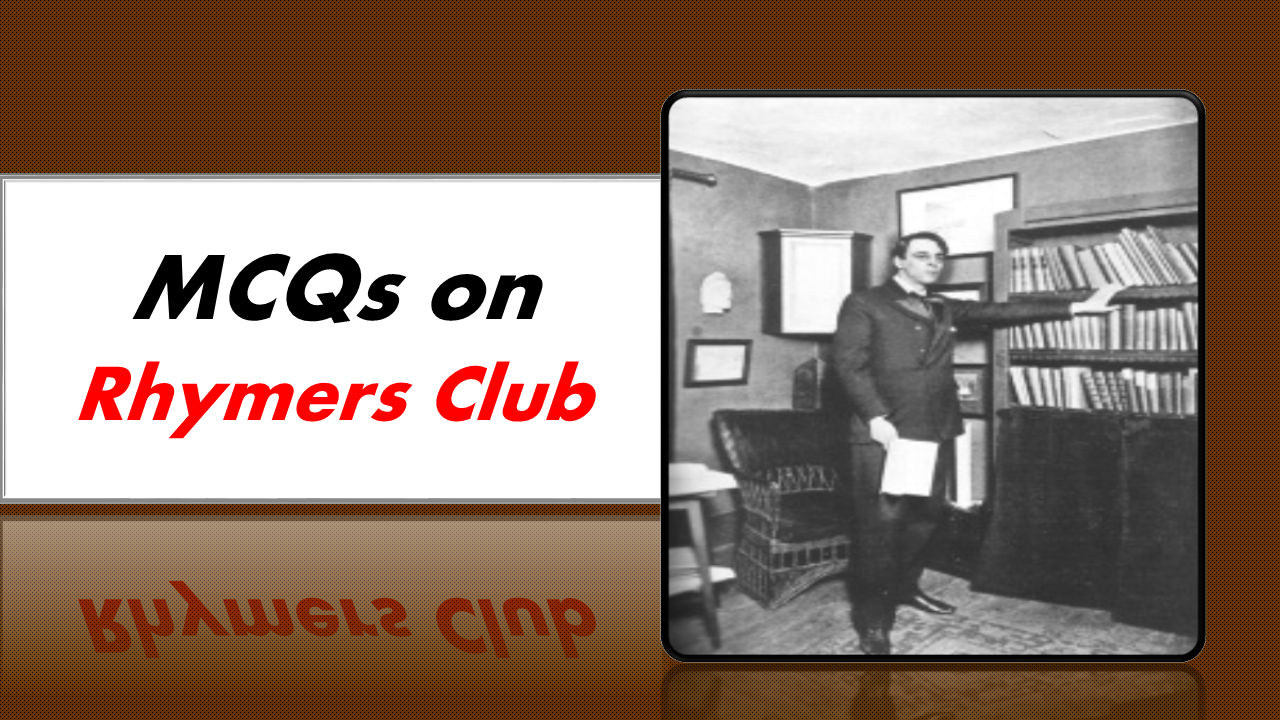
MCQs on Rhymers Club
1. Who is the founder of Rhymers Club?
a. John Keats
b. William Wordsworth
c. Samuel Taylor Coleridge
d. Percy Bysshe Shelley
2. In which century was Rhymers Club established?
a. 17th century
b. 18th century
c. 19th century
d. 20th century
3. Rhymers Club was known for its association with which literary movement?
a. Romanticism
b. Realism
c. Modernism
d. Victorianism
4. Which city served as the primary location for Rhymers Club meetings?
a. London
b. Paris
c. Rome
d. New York
5. The Rhymers Club was a gathering place for poets and writers during which period?
a. Renaissance
b. Enlightenment
c. Victorian era
d. Industrial Revolution
6. Who among the following poets was NOT associated with Rhymers Club?
a. W.B. Yeats
b. Oscar Wilde
c. Emily Dickinson
d. Lionel Johnson
7. Rhymers Club was known for promoting poetry that focused on:
a. Nature
b. Urban life
c. Mythology
d. Social issuesMCQs on Rhymers Club
8. Which poet famously described Rhymers Club as “a coterie of incapables”?
a. T.S. Eliot
b. Ezra Pound
c. Robert FrostMCQs on Rhymers Club
d. Langston Hughes
9. Rhymers Club played a significant role in the revival of interest in which poetic form?
a. Sonnet
b. Haiku
c. Free verseMCQs on Rhymers Club
d. Villanelle
10. The Rhymers Club was active during which decades of the 20th century?
a. 1910s and 1920s
b. 1930s and 1940s
c. 1950s and 1960s
d. 1970s and 1980s
11. Which literary journal was associated with Rhymers Club?
a. The Dial
b. The Criterion
c. The Little Review
d. The New Age
Also Read-
12. The Rhymers Club was known for its emphasis on:
a. Traditionalism
b. Experimentalism
c. Surrealism
d. Symbolism
13. Which poet, a member of Rhymers Club, won the Nobel Prize in Literature?
a. W.H. Auden
b. Wilfred Owen
c. Rudyard Kipling
d. D.H. Lawrence
14. Rhymers Club meetings were characterized by discussions on:
a. Politics
b. Philosophy
c. Aesthetics
d. All of the above
15. What was the primary purpose of Rhymers Club?
a. Political activism
b. Literary criticism
c. Poetry readings and discussions
d. Art exhibitions
16. The Rhymers Club was influenced by the ideas of which literary figure?
a. John Milton
b. William Blake
c. William Butler Yeats
d. Alexander Pope
17. Which member of Rhymers Club was known for his involvement in the Irish Literary Revival?
a. W.B. Yeats
b. T.S. Eliot
c. Ezra Pound
d. W.H. Auden
18. The Rhymers Club had connections with which other artistic movements?
a. Cubism
b. Surrealism
c. Dadaism
d. All of the above
19. Which member of Rhymers Club wrote “The Waste Land”?
a. T.S. Eliot
b. W.H. Auden
c. Wilfred Owen
d. Ezra Pound
20. Rhymers Club was instrumental in fostering the careers of several poets who later became known as:
a. Imagists
b. Beat GenerationMCQs on Rhymers Club
c. Metaphysical poets
d. Harlem Renaissance writers
21. The Rhymers Club meetings were known for their:
a. Formality and exclusivity
b. Informality and opennessMCQs on Rhymers Club
c. Political activism
d. Literary debates
22. Rhymers Club was influenced by the ideas of the Symbolist movement, particularly from which country?
a. France
b. Germany
c. Italy
d. SpainMCQs on Rhymers Club
23. The members of Rhymers Club were often criticized for their:
a. Traditionalist views
b. Progressive views
c. Experimental writing styles
d. Political ideologies
24. Rhymers Club disbanded during which historical event?
a. World War I
b. World War II
c. The Russian Revolution
d. The Great Depression
25. The Rhymers Club contributed to the development of which literary form in poetry?
a. Epic
b. Lyric
c. DramaMCQs on Rhymers Club
d. Satire
26. Who among the following was a female poet associated with Rhymers Club?
a. Sylvia Plath
b. Edna St. Vincent Millay
c. Charlotte Mew
d. Elizabeth Barrett BrowningMCQs on Rhymers Club
27. Rhymers Club members were known for their interest in:
a. Eastern philosophy
b. Scientific discoveries
c. Occultism
d. Existentialism
28. Which member of Rhymers Club was known for his war poetry?
a. Siegfried Sassoon
b. W.H. Auden
c. T.S. Eliot
d. Robert Frost
29. The Rhymers Club had connections with which literary movement that sought to break from traditional forms and language?
a. Romanticism
b. Modernism
c. Realism
d. Victorianism
30. The Rhymers Club had an impact on the development of which poetic genre?
a. Confessional poetry
b. Metaphysical poetry
c. Surrealist poetry
d. Epic poetry
31. Who was the editor of “The New Age,” a magazine associated with Rhymers Club?
a. Ezra Pound
b. Ford Madox Ford
c. T.S. Eliot
d. W.B. Yeats
32. Rhymers Club was known for its association with which art form?
a. Painting
b. Sculpture
c. Photography
d. Music
33. Which member of Rhymers Club was influenced by psychoanalysis in his literary works?
a. W.H. Auden
b. T.S. Eliot
c. Wilfred Owen
d. D.H. Lawrence
34. The Rhy mer’s Club meetings often featured discussions on:
a. Literary theory
b. Political philosophy
c. Linguistics
d. Aesthetics
35. Rhymers Club was actively involved in debates related to:
a. Feminism
b. Marxism
c. Existentialism
d. All of the above
36. Which member of Rhymers Club wrote “The Love Song of J. Alfred Prufrock”?
a. W.B. Yeats
b. T.S. Eliot
c. Ezra Pound
d. Wilfred Owen
37. Rhymers Club was known for its engagement with which social issues?
a. Civil rights
b. Women’s rights
c. Labor rights
d. All of the above
38. Which member of Rhymers Club was a leading figure in the Imagist movement?
a. W.B. Yeats
b. T.S. Eliot
c. Ezra Pound
d. W.H. Auden
39. The Rhymers Club was founded as a reaction against:
a. Romanticism
b. Realism
c. Symbolism
d. Naturalism
40. Which member of Rhymers Club was a key figure in the Harlem Renaissance?
a. Langston Hughes
b. Claude McKay
c. Countee Cullen
d. Zora Neale Hurston
41. The Rhymers Club was known for its interest in:
a. Folk traditions
b. Pop culture
c. Futurism
d. Minimalism
42. Rhymers Club was involved in the publication of:
a. Poetry anthologies
b. Political manifestos
c. Science fiction novels
d. Art criticism
43. The Rhymers Club meetings were attended by poets from which geographic region?
a. Europe
b. Asia
c. North America
d. All of the above
44. Which member of Rhymers Club was associated with the Vorticist movement?
a. T.S. Eliot
b. Ezra Pound
c. Wyndham Lewis
d. D.H. Lawrence
45. Rhymers Club contributed to the development of which literary technique in poetry?
a. Stream of consciousness
b. Ekphrasis
c. Irony
d. Alliteration
46. The Rhymers Club had an impact on the publication of poetry in which format?
a. Broadsheets
b. Chapbooks
c. Literary magazines
d. All of the above
47. Which member of Rhymers Club was known for his involvement in theater and drama?
a. W.B. Yeats
b. T.S. Eliot
c. Ezra Pound
d. W.H. Auden
48. Rhymers Club was known for its engagement with which artistic discipline in addition to literature?
a. Sculpture
b. Painting
c. Music
d. Dance
49. The Rhymers Club was influenced by the ideas of which philosopher?
a. Friedrich Nietzsche
b. Karl Marx
c. Søren Kierkegaard
d. Jean-Jacques Rousseau
50. Rhymers Club had an impact on the development of which poetic theme?
a. Nature and landscape
b. War and conflict
c. Love and relationships
d. All of the above
1. c. Samuel Taylor Coleridge
2. d. 20th century
3. a. Romanticism
4. a. London
5. c. 19th century
6. c. Emily Dickinson
7. b. Urban life
8. b. Ezra PoundMCQs on Rhymers Club
9. a. SonnetMCQs on Rhymers Club
10. a. 1910s and 1920s
11. b. The Criterion
12. b. Experimentalism
13. a. W.H. Auden
14. d. All of the aboveMCQs on Rhymers Club
15. c. Poetry readings and discussions
16. a. John MiltonMCQs on Rhymers Club
17. a. W.B. Yeats
18. d. All of the aboveMCQs on Rhymers Club
19. a. T.S. Eliot
20. a. Imagists
21. a. Formality and exclusivity
22. a. France
23. b. Progressive views
24. a. World War I
25. b. Lyric
26. c. Charlotte Mew
27. c. Occultism
28. a. Siegfried Sassoon
29. b. Modernism
30. c. Surrealist poetry
31. b. Ford Madox Ford
32. a. Painting
33. d. D.H. Lawrence
34. d. Aesthetics
35. d. All of the aboveMCQs on Rhymers Club
36. b. T.S. Eliot
37. d. All of the above
38. c. Ezra PoundMCQs on Rhymers Club
39. a. Romanticism
40. a. Langston Hughes
41. a. Folk traditionsMCQs on Rhymers Club
42. a. Poetry anthologies
43. d. All of the above
44. c. Wyndham Lewis
45. a. Stream of consciousness
46. c. Literary magazines
47. b. T.S. Eliot
48. c. Music
49. a. Friedrich Nietzsche
50. d. All of the above

