2. Discuss the classification of morphemes. Illustrate with suitable examples (20)
ANSWER :
IGNOU MEG 04 Solved Assignment Q2 Answer 2025-26 – Language is a complex system made up of sounds, words, and meanings. At the heart of this system lies the concept of the morpheme, the smallest meaningful unit in a language. While a word is the smallest free-standing unit of language, a morpheme is the smallest unit that carries meaning. Some words consist of a single morpheme (like book or run), while others are made up of multiple morphemes (like books, running, or unhappiness). The study of morphemes and their structure is known as morphology—a central branch of linguistics.
Understanding the classification of morphemes helps linguists analyze how words are formed, how meanings are modified, and how language evolves. Morphemes can be classified in several ways—based on function, form, and independence. The major categories are free and bound morphemes, derivational and inflectional morphemes, and lexical and grammatical morphemes. Each category plays a specific role in building the meaning and structure of words.
1. Free and Bound Morphemes
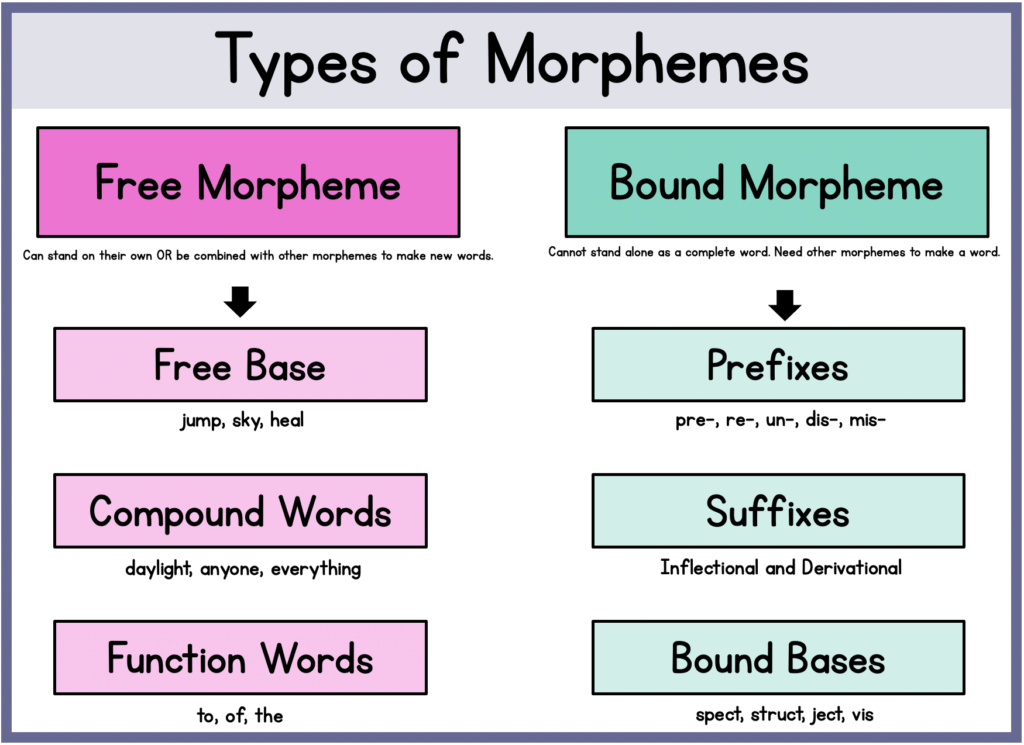
The most basic distinction among morphemes is between free morphemes and bound morphemes.
(a) Free Morphemes
A free morpheme is one that can stand alone as a word and carry meaning independently. These morphemes do not need to attach to other morphemes to be meaningful. For example:
-
book, house, tree, run, happy, blue, walk, girl.
In these examples, each word is a free morpheme because it can appear independently and still make sense. Free morphemes are often content words—nouns, verbs, adjectives, or adverbs—that carry the core meaning of a sentence.
Free morphemes can be further divided into lexical and functional morphemes (discussed later).
(b) Bound Morphemes
IGNOU MEG 04 Solved Assignment Q2 Answer 2025-26- A bound morpheme cannot stand alone. It must be attached to a free morpheme (or another bound morpheme) to convey meaning. Bound morphemes include prefixes, suffixes, infixes, and circumfixes. For example:
-
un- in unhappy
-
-s in books
-
-ed in walked
-
-ness in darkness
Each of these elements carries meaning—“un-” indicates negation, “-s” indicates plurality, “-ed” shows past tense, and “-ness” forms an abstract noun. However, they cannot stand by themselves; they must be attached to a base or root word.
Bound morphemes are essential in forming new words or modifying existing ones. For instance:
-
happy (free morpheme) → unhappy (bound + free morpheme)
-
play (free morpheme) → played (free + bound morpheme)
2. Root, Stem, and Affix
Before discussing further types, it is useful to distinguish between root, stem, and affix—concepts closely related to morphemes.
-
Root: The core morpheme that carries the primary meaning of a word. It cannot be further divided into smaller meaningful parts.
Example: In unhappiness, the root is happy. -
Stem: The part of a word to which affixes (prefixes, suffixes) are added. It can be the root alone or the root plus some other morphemes.
Example: In unhappiness, unhappy is the stem to which -ness is added. -
Affix: A bound morpheme that attaches to a root or stem. Affixes can be prefixes (before the root), suffixes (after the root), infixes (inserted within the root), or circumfixes (attached to both ends of the root).
Examples:-
Prefix: un- in unfair
-
Suffix: -ly in slowly
-
Infix: Rare in English, but found in other languages such as Tagalog (sulat → sumulat = “to write”).
-
Circumfix: Found in German, e.g., ge–lieb–t (beloved).
-
3. Derivational and Inflectional Morphemes
IGNOU MEG 04 Solved Assignment Q2 Answer 2025-26– Bound morphemes are further classified into derivational and inflectional morphemes depending on their function.
(a) Derivational Morphemes
Derivational morphemes are used to create new words by changing either the grammatical category (part of speech) or the basic meaning of the root. They are highly productive in forming new vocabulary. For example:
| Base Word | Derivational Morpheme | New Word | Word Class Change |
|---|---|---|---|
| happy | un- | unhappy | meaning change (negation) |
| nation | -al | national | noun → adjective |
| create | -tion | creation | verb → noun |
| quick | -ly | quickly | adjective → adverb |
Derivational morphemes often lead to new dictionary entries because the resulting words have meanings distinct from the base. The process of adding derivational morphemes is called derivation.
For instance:
-
friend → friendship (adds the sense of state/condition)
-
hope → hopeless (adds the sense of absence)
-
read → readable (adds the sense of possibility)
Derivational morphemes can be both prefixes (un-, dis-, re-) and suffixes (-ment, -ness, -ful, -ize, -er).
They are often less predictable than inflectional morphemes and may cause changes in pronunciation or spelling (e.g., electric → electricity).
(b) Inflectional Morphemes
IGNOU MEG 04 Solved Assignment Q2 Answer 2025-26– Inflectional morphemes do not create new words but modify a word’s form to indicate grammatical functions such as tense, number, person, gender, or comparison. They mark relationships between words in a sentence rather than creating new meanings.
In English, there are only eight inflectional morphemes:
| Function | Example | Word | Inflected Form |
|---|---|---|---|
| Plural | -s | cat | cats |
| Possessive | -’s | girl | girl’s |
| Third person singular present | -s | run | runs |
| Past tense | -ed | walk | walked |
| Past participle | -en | eat | eaten |
| Present participle | -ing | go | going |
| Comparative | -er | big | bigger |
| Superlative | -est | tall | tallest |
These morphemes do not change the core meaning or the part of speech of the word. For example:
-
book → books (still a noun)
-
walk → walked (still a verb)
-
fast → faster (still an adjective)
Inflectional morphemes are thus grammatical markers, helping to express syntactic relationships in a sentence, such as subject-verb agreement or noun plurality.
4. Lexical and Grammatical Morphemes
IGNOU MEG 04 Solved Assignment Q2 Answer 2025-26- Another way to classify morphemes is based on their semantic (meaning-based) function—whether they carry lexical content or serve grammatical purposes.
(a) Lexical Morphemes
Lexical morphemes are those that carry concrete, real-world meaning. They form the core vocabulary of a language, representing objects, actions, qualities, and ideas. Most free morphemes fall into this category. Examples include:
-
dog, run, beautiful, sky, honesty, love.
Lexical morphemes are open class words, meaning that new ones can be freely created as the language evolves. For instance, modern English has added words like selfie, download, cybercrime, etc.
(b) Grammatical Morphemes
Grammatical morphemes, also called functional morphemes, express grammatical relationships rather than lexical meaning. They include prepositions, conjunctions, articles, auxiliary verbs, and pronouns—words such as:
-
in, on, at, and, the, is, was, he, she.
These morphemes form a closed class, meaning new grammatical morphemes are rarely added to a language. Their function is structural rather than semantic—they help link lexical morphemes in sentences.
For example:
-
In the sentence The boy is running in the park, the words the, is, and in are grammatical morphemes, while boy, run, and park are lexical morphemes.
5. Allomorphs
IGNOU MEG 04 Solved Assignment Q2 Answer 2025-26– A related concept in the study of morphemes is the allomorph—different phonological forms of the same morpheme. For instance, the plural morpheme -s in English has three allomorphs:
-
/s/ as in cats,
-
/z/ as in dogs,
-
/ɪz/ as in buses.
All three forms represent the same grammatical concept (plurality) but appear differently depending on the phonetic context. Understanding allomorphs highlights the flexibility and phonological adaptation of morphemes in actual speech.
6. Importance of Classifying Morphemes
Classifying morphemes helps linguists and language learners:
-
Understand word formation processes—how complex words are built from smaller units.
-
Analyze grammatical relationships between words in a sentence.
-
Study language change and development, including the creation of new words.
-
Improve language teaching and learning, as recognizing morphemes enhances vocabulary comprehension and grammar awareness.
Morphological analysis also assists in computational linguistics, lexicography, and language translation, where understanding the structure of words is essential for accurate interpretation.
Conclusion
IGNOU MEG 04 Solved Assignment Q2 Answer 2025-26– Morphemes are the building blocks of language, carrying both meaning and grammatical function. Their classification—into free and bound, derivational and inflectional, lexical and grammatical—helps us understand how words are structured and how they function in communication. Free morphemes stand alone as meaningful units, while bound morphemes attach to them to create or modify meaning. Derivational morphemes expand vocabulary, while inflectional ones express grammatical relations. Lexical morphemes contribute meaning, while grammatical ones provide structure. Together, these systems reveal the intricate design of language, showing that even the smallest linguistic units play a vital role in shaping how we express thought and meaning.